Guest Post: Exploring what he considers the last good game in the series Hax Monster reminises about Far Cry 2

Posted by: Jason Silverain / Category: , ,


Like with your pride the first time you manage to make a fire in the woods without matches, the amazement about a good video game series simmers down when it all starts burning itself to the ground. Series like Call of Duty, Assassin’s Creed or Thief are masters of their genre and pioneers in gaming technology until suddenly they look back, realize that they’re so popular they’ll never have to do a damn until the end of days and spend the rest of their runtime extensively testing that feeling. And usually you can point out one game that was the turning point; a game that perhaps wasn’t bad itself but which ushered in the era of minimum-effort player-milking games. With Call of Duty it was the first Modern Warfare and with Thief it was Thief (god, that sounds stupid). 
  
With the Far Cry series, that game was Far Cry 3. While immensely popular and actually quite good in it’s own right, it forebode a time where Ubisoft would not know what to do with the franchise; for Far Cry 4 they simply did Far Cry 3 again with some snow added and Far Cry Primal isn’t really a sequel at all as it has as much to do with the other Far Cry instalments as it has to do with the newest instalment of Jaffa Cakes. Therefore I want to reminisce about the last undoubtedly good Far Cry that I remember: Far Cry 2.
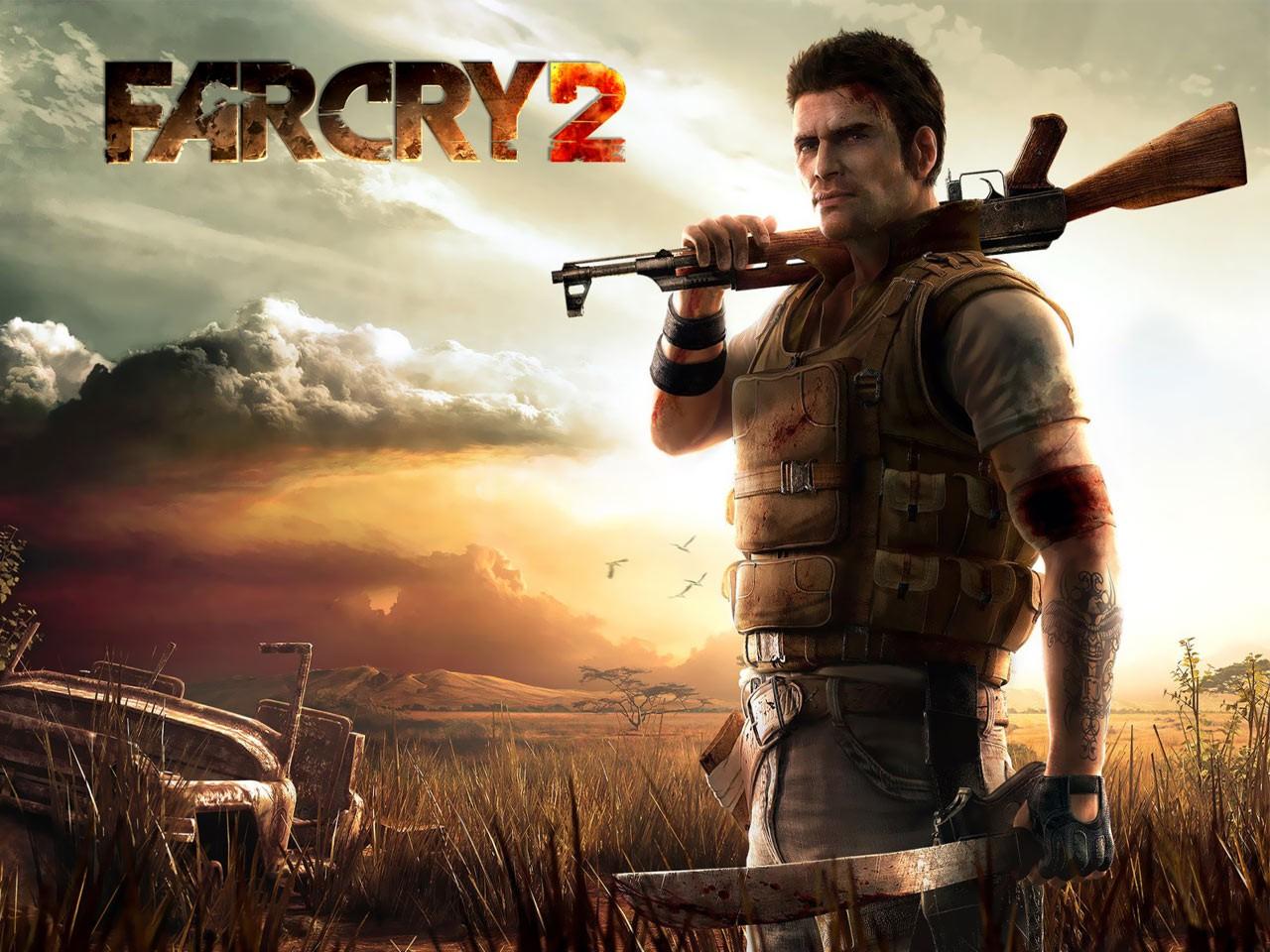


In Far Cry 2 you take the role of a mercenary sent out to an African country where two factions are fighting a long civil war. Your job there is to take out an arms dealer named ‘The Jackal’ and to do this you do jobs for the warring factions and a truckload of side missions for all kinds of nutters that are all in their own way trying to get a slice of the African pie that is the country’s vanishing wealth. Inbetween the mission you get an open game world with cars and enemies smeared out evenly like butter on toast, with the freedom to go pretty much everywhere. So far, so generic. Then what is it that makes this title the hidden jewel that it is? I’ll show you!

Pub quiz time! Name as many games as possible that are set in Africa!

Well, how did you do? I myself can only think of Serious Sam 3, although calling Egypt an African country is like calling Origin serious competition for Steam; strictly true but practically not quite. The only other African game that comes up for me is Far Cry 2. So on the originality scoreboard Far Cry already marks highly on ‘setting’ for me. The setting is perhaps the biggest and most important ingredient of Far Cry 2’s recipe that I devour with so much gusto. As soon as you start the game up you are presented with an overwhelming feeling of being in that dry, war-torn hostile place and you are immediately immersed eyehole-deep. The colour palate delivers the dryness of sub-Saharan African steppes in dry season, the vegetation moves naturally and is very real, the light is beautiful and intense. 
  
You get to soak up all of the setting during the game’s very well-executed intro cinematic that for me is only really bested by Bioshock’s bathysphere ride. During this first moment of the game you are driven around a large part of the map where your cheerful cabdriver acquaints you with fires, oppressive troops, panicking civilians and misery. Normally this kind of exposition is all setup and no payoff, but when you do actually roam freely around the world you get the same feeling as when you were in the taxi. With the game’s superbly subtle soundtrack and beautiful lighting the game world always has this characteristic looming feeling of threat over it. Everything feels even more real when you take a moment to spy on a few enemy camps from a distance. All those soldiers chat with each other in really well-voice-acted dialogues and are constantly doing things normal people do as well, like pissing up trees and try to get mobile reception for hours. A lot of little details like this make the world feel ever so vibrant. And although this is nothing as intense like, say, Spec Ops: The Line, Far Cry 2 managed to do quite well when it comes to setting up a miserable country with scared people, traumatized by war.

 
For those curious here is a video of the intro - Silverain

This is, of course, all framework. What is the actual painting part of the painting like? Very briefly described, the core gameplay of Far Cry 2 is that of it’s sequel, only more slowly paced and less forgiving. The slower pace has to do the higher difficulty of stealthing and the lower movement speed. This is a lot closer to Arma 2 than it is to, say, Call of Duty. As far as the unforgiving is concerned, Far Cry 2 is like a cheap hotel bed: full of sand, blood and, most importantly: obnoxiously hard. On higher difficulty settings especially you will never win a fight unless you got in a perfect position beforehand and mapped every enemy out for yourself. 

 An example of perfect positioning.

Combat from a car is a pain in the arse in particular because the AI always drives faster than you do and can have a gunner in the car while someone else is driving. Your chances are therefore very slim in chases. Then there is the tricky health system. There is practically no regenerating health and once you are at low health, pressing the heal button makes your character arduously extract the bullets from his arm or put a bandage on it which takes about as much time as getting three hundred involuntary metal piercings all over your body. You also don’t have a minimap that is always visible and weapons degrade quickly, which can be very frustrating unless you neurotically switch your gun for a new one every single time you pass by a gunstore. So the game is harsh, but that too builds atmosphere. Where in Far Cry 3 you felt like some kind of demi-god that could survive a breezeblock to the face, you actually feel very human while playing Far Cry 2. You are still a squishy walking pile of meat, stuck together with flimsy bone. That feeling is quite rare in shooters these days.
 

Then there is another fine bit of original immersing game design: the buddy system. In Far Cry 2 you, over the course of the game, meet a bunch of NPC’s who become your friends and give you side missions. One particular buddy also gives you optional objectives for main story missions and, most remarkably, another buddy will appear into the game and revive you whenever you die. Then he fights alongside you. That and their wide variety in looks and, albeit shallow, personalities makes you care about them. It’s only a shame that they are just like you: walking piles of brittle meat. They die the moment an enemy so much as looks their way and sometimes when they are downed, if the gods of random number generators are not on your side, they die no matter how hard you try to revive them. For me, whenever that happened, it was actually a sad moment. All of them can die. This frailness also makes them feel like actual people that you care about, not refrigerators with miniguns strapped to their pecs that kill all threats for you. 


Then there are a bunch of other details that make the game as great as it is. Sometimes, when you shoot an enemy, he is downed but not dead. Of course you can just shoot him again to kill him but if you don’t do that, the enemies think you have left and the stars have aligned then a teammate of his will come up to revive him. When he is being treated the panic in the injured soldier’s voice is also really well-acted and believable. In general this game has really good voice acting. It is odd, however, that things like enemy taunts are really well-acted while a lot of the story cutscenes have really dull, uninterested voice actors. Luckily, considering that there are not that many scenes of that kind, it’s no dealbreaker. Then there’s stealthing. Far Cry 3 gave you an enormous arrow indication that lit up when an enemy so much as smelled your farts but here, there’s nothing like that. You actually have to listen to what enemies are saying to know if they spotted you or not, which will happen very quickly because this is not Skyrim, where you can stay invisible in plain sight when you are at a high level. Here enemies actually have realistic cones of vision so staying hidden is really hard because you can’t allow yourself to see the enemies either, or they’ll see you. 
 
If all this is great, then why was this game forgotten so much that you need me to tell you about it again? Beyond the high difficulty that can be attributed to a few factors. Firstly, missions are quite repetitive. Missions from the same sources always have the same layout and objective and only differ in location. Then there’s the really annoying feature that this game is a sandbox in the same way as Borderlands 2 for instance: not really an open world, but a bunch of linear paths that cross each other a lot. There are so many mountains that you can’t cross that the game world is an enormous Swiss cheese. The kind of gaming audience that spends hours in Skyrim walking over mountains just for the sake of taking the direct route isn’t going to like that. Then there was the money system that I didn’t really like. Money was very limited and could only come from the finite number of missions or from exploration. Because of this you could never really get a lot of weapons and that is a shame because there aren’t really many in the first place. 


On console ports aiming your gun felt as clunky and slow as redirecting a nuclear submarine and the multiplayer was practically unplayable because of that it required ALL twenty-or-so people in the game to ready up for the next round. On the PC version I couldn’t even get it to work in the first place. The console version also has a ported level editor that is more annoying to work with than an autistic baboon. I can’t imagine why that was designed in the first place. Furthermore I think it was a shame that we don’t actually notice the war itself going on beyond one or two scripted events where the two factions actually fight each other. The war’s feeling of threat is there alright but we never see it actually happening. If I’d lure enemies from one side to a camp of the other faction they would just all fight me like they are one team. They are supposed to be actively fighting each other if you’d believe the story, but you barely see that happen beyond fixed moments of exposition.

Beyond that there are a few technical imperfections. Clipping issues are very common, especially when you shoot someone sitting in a car and enemies have this curious tendency to end up in a shoulder-shrugging position when they are dead. Explosions can make large things like cars spaz out and one other glitch once caused the enemies I was fighting to suddenly stat shooting the corpse of one former comrade of theirs that I just killed. Then there’s the slight issue that the AI can’t drive DLC-added vehicles. 

 
So, undoubtedly this game requires your attention if you’re up for a shooter that’s a little more organic than a nuclear power plant. I can’t guarantee that it will work on newer computers because I can’t run my old disc copy on my Windows 10 machine, but that might also be because of that the disc is seven years old. Avoid the console ports and just get it for PC. Get it and enjoy yourself, just try not to run over too many zebras on the way!


Read more »

Chapter Master Update: A New Hope, Journier rising.

Posted by: Jason Silverain / Category: , , , ,


You may remember in my last Chapter Master post that there has been some discussion amongst fans about hiring a programmer to debug Dukes released source code. It has been confirmed that one such member Journier as of the 2nd of October has done just that and here is the progress they have had so far:


Update 1
Oddities
We cleared up more code today found something called "thatone" random number given to this variable and its checked in a 100 different places... left it where it was for fear for the chaos gods.

Bug fixes

  • Fixed a crash related to space hulks.
  • Fixed an issue where to find a event, the game generated objects in every system to find the system the event took place in, Made it NOT generate those temporary objects oddly so many of them...
  • Fixed an issue with ancient ruins on planets I believe the ones you explore, so that they will work all the time now, apparently there was a chance it wouldn't do anything

Found a lot on the Necron tombs related stuff, this will be a day of work by itself.
Other stuff

Rewrote descriptions for relic rooms. Spiced them up for fun to break the monotony. added some DF reference.
Got a massive headache from cleaning code up and ended the day.
Update #2

Today we went through the Massive Random Event file, and restructured it massively for readability. cut its size down from over 1000 lines to below 300 lines. Separated the random events to their own respective files to easily find and modify their effects instead of inside of a single giant random event file.


Also, never take the shitty luck attribute in game because that effects every random event you could imagine badly. probably the only game I can remember where the bad luck attribute actually probably did something noticeable.

Found the Fucko string... giant dense code thing of death. IDK what it is, left it alone.

Cleaned up the chaos invasion random event, cleaned up the necron event to avoid any crashes in relation to their awakening maybe.

If only you guys knew how many memes are in the code.

Literally we added a single DF meme into the trophy room. Theres memes in this game from the code on up. Literally everywhere...

They were already there.

Update #3


Fixed star generation to give you a range of star numbers to have 65-75, before it was trying 120x to create 70 stars, and if it failed the fewer stars youd have. fixed that.
changed the vehicle system to a more reasonable version, faster, easier to work with and change for future revisions. It doesnt sound like much until you understand that the code base isnt properly spaced out, 1000 lines in some of these files can equal 2000 lines properly spaced a majority of the time...

found something called this in the code
Quote
then old_dudes+=1;
no clue, whats being referenced save it for later.

Update 3.1

Made armors a Moddable file so anyone can change the values once game is installed.

In spite of this don't get your hopes up too soon, Journier is refusing to post updated code at this point and is focusing on bug fixes rather than updates. Rather reasonably he has requested for the community to wait up to 2 months before he does release the code and to keep posting crash logs from Dukes source code.

Any way I can help out with this Journier? Admittedly I don't know very much about programming but I'm working on Chapter Master as a way to learn my own way. But since the code appears to be a big mess of what-the-%&$# I'm having trouble understanding much of it. I have fixed a couple of bugs on my own though (Tried working on the renegade crash bug but at this point I'm stumped). Basically I want to assist with bug fixing.

Since you're working on cleaning up the code I'm hoping that it'll make fixing bugs much less painful for me.

honestly just wait, there's gonna be a massive release coming up in a month or months that will get all the code into a proper debuggable state that is readable If you guys want start posting bug reports on a regular basis, where you were ( what screen) what you were clicking  etc. as detailed as possible.

That way when we get to a section we can refer back to your bug reports to see if there's any silly code. Which we have run through a chunk of it.

There will be a gitlab repository created in the next 2 months. thats the timeline we are aiming for , for you guys.

TLDR : Please give crash logs and where you were in the crash and what you were exactly doing. We need bug reports. good bug reports. please and thanks.

And possibly if you guys really want to help find or put your little butts out there to find decent pixel artists for the game to get away from the IP. Dark warlike images of Interstellar Army Simulator 2015.


Now some in community who have offered to help with the code and have been turned down for now are starting to believe that Journier is keeping it to himself to possibly to monetize the development in a similar way to Duke. Thankfully the more sensible members of the community are realising that too many people working on the project without decent communication and understanding of what is a tangled mess of code is a recipe for disaster so the drama has been halted for now.

To play my own part I'm still hosting backups of Dukes links and files which you can obtain below:

Interstellar Army Simulator 2015: Source Code: Link
Chapter Master 0.6555: Source Code: Link
Original Design Document (former project): Link
Features That Were Planned: Link

Don't know What Chapter Master is? The original review is here.
Just want to play the game? Then Interstellar Army Simulator and the mod and be downloaded here.


Read more »

Halloween Review Special: Videos Galore

Posted by: Jason Silverain / Category: , , , ,


Now you may have seen that in the past I've done video game videos alongside HaxMonster, in addition to help with his channel I've also done a number of video reviews but not all of them make it as blog posts here.
So today I'm gathering all the brain munching, apocalypse surviving videos I've made for a Halloween special.

To start here is my review of OMG Zombies by Laughing Jackal LTD, name aside its rather decent.  


 My somewhat abruptly ended Lets Play of Organ Trail and HaxMonsters own attempt:


Finally to end on a positive note we have the Halloween update for Bardbarian.


Fancy a more traditional post? Check out Pumpkin Carving here.


Read more »

Simbrix: A curious hybrid of Lego, Jigsaws and Hama Beads

Posted by: Jason Silverain / Category: , , , , ,


Having the fortune to head down to the Gamecity events in Nottingham with the lovely lady of Buzy Bobbins we found ourselves surprised by just how packed the lobby for the National Video Games Gallery was that day, one of the main culprits was this little stall run by Assim Ishaque the founder and inventor of Simbrix.

My first sight of Simbrix

Now I must confess that at first glance through the crowd of children I mistook them for Hama beads but over hearing some parents talking to who I now know to be Mr Ishaque caught my attention, these were not bored parents waiting at the stall they were joining in and having just as much fun often enquiring about the stall.
My interest peaked I squeeze through the crowd to examine the table to suddenly find myself offered a fist full of the Simbrix to keep by Mr Ishaque, respectfully declining (my pockets already rather full at the time) I did manage to have a rather improvised interview with Mr Ishaque while examining the Simbrix.

 You can tell that the chaps at the National Video Games Gallery got their hands on these right away.

It seems that Mr Ishaque got the initial idea for Simbrix when his daughter became very fond of Hama beads, the Hama beads often got lost or patterns scattered at a slight knock and often his children got bored of old projects which had been ironed and needed to purchase more beads for new ones. 
Wishing that the beads were reusable and easier to use in general Mr Ishaque began designing his own which after 400 prototype designs that experimented with different materials and shapes that could interlock over the last 2 years.

Earlier this year Mr Ishaque actually managed to get some local support for the project and appeared in Toy news, the Nottingham Post and BBC Radio Nottingham as well as attempting to fund the project on Kickstarter, unfortunately this drive failed but undeterred his team continued to improve the Simbrix and tried again.
 This new Kickstarter has not only succeeded but at the time of writing has hit 216% of its goal and still the Simbrix are been improved, the Kickstarter continues until the 11th of November 2015 so I recommend getting in and grabbing the Simbrix at a discount price early. I recommend reading the Kickstarter anyway as it contains a lot of history and background into this 2 year project and is quite interesting.

Now I've given you the background lets get into the juicy details of the bricks themselves.

The Simbrix are slightly larger that Hama beads, are considerably thicker and lock together in a similar way to a jigsaw but also they can be iron like Hama beads for a permanent connection.
These differences do mean that many completed projects will be larger in size than if they were made in Hama but they are far less brittle if ironed, this increase in size also means its easer for older people and those with large fingers to use them.

 Simbrix figures on the left while Professor Layton is in Hama

The locking design is a great measure of improvement over Hama Beads in the fact that tweezers and pegboards are not require, the structures are robust enough that ironing is optional so kids can be left to play with them unattended (though their small size means they are not suitable for very young children who may swallow them).  

The locking design has been improved since I last tried them, the Simbrixs I used seemed rather sturdy but they came apart easily if pressure was applied correctly, apparently some colours of that run has issues (I noticed the pink tended to slip and didn't hold well) but they have been solved and here is a glimpse of the improvements.


 Apparently this new batch is the first time the entire colour pallet has held together so well and  has been put through a series of tests including the connection and disconnection of parts, a drop test, been thrown, been used as a frisbee and bending. In addition there are now glow in the dark Simbrix as well.

The astute amongst you may notice that that there are only 18 colours in the picture above and that is where Simbrix is currently lagging, Hama Beads are available in over 50 different colours meaning that you can get greater degrees of accuracy and shading however as Simbrix Develop I imagine their available pallet will expand in time.

Also bead for brix Simbrix are a more expensive initial purchase at the beginning however their re-usability and the lack of tools/supervision needed to use them means that in the long run (if you are not ironing them) they actually are cheaper. The Simbrix are also neutral in design giving more creative freedom whilst Hama Beads are often bought in box sets around a theme.  


 Simbrix and Hama Bead creations line the Toast Bar of the Nation Video Games Gallery

In short I rather like them, they seem like a natural evolution of Hama Beads, while if I wanted to do fine artwork I'd go for Hama beads I would definitely consider Simbrix as a more fun and cheaper option.  

Want to know more?
Buzy Bobbins gives a crafter's perspective on Simbrix in their article.

Go to Simbrix directly through:
Never heard of the Nottingham National Video Games Gallery check it out here. 


Read more »

A day at Frequency 2015

Posted by: Jason Silverain / Category: , , ,


While not in the best of health I took a trip into Lincoln city centre with some friends on the 25th after hearing about the Frequency Festival, this is the third Frequency event and will be running until the 1st of November. 


If you are unfamiliar with the Frequency Festival it is a mixture of unusual art exhibitions, interactive performances, and workshops, each festival has a different theme and this year it is Liberation.

I've never had the chance to attend the past events due to other engagements so even in my ill state I was eager to explore what was on offer.
Now there are over 30 events occurring over the next week so I'm going to boil this list down to a few of my favourites.

co_LAB

co_LAB is the Collaboration Laboratory Research Network at the University of Lincoln and in their own words " bringing together people from different fields, disciplines and contexts to collaborate on innovative trans-media projects."
Now this is more of a series of activities than the traditional art that makes up the Frequency Festival
the first activity is called Blind Data and was one of most thought producing events to myself.

In Blind Date you are given a choice of several files each containing portfolio's of three individuals, these portfolios have within them the same sort of information that the NSA would be able to collect on each person. Examples include search terms, email keywords, illegal activity and recent purchases and from this information you have to decide who if any you would investigate further. 
It is an interesting thought study and the students running the stall in the Waterside Centre are eager to hear feedback from participants. I have also been advised that anyone who tries this should look up information about PRISM to learn more.   

Caught In The Web was unfortunately not available during my trip as someone accidentally deleted the program but the students pulled an all nighter and managed to remake the experience using the last build they had created so should be available for everyone. This Oculus Rift virtual experience aims to challenge public apathy towards the mass surveillance of our digital lives by creating a 3D web browser and exploring the history of the internet. You can watch the developments that changed the digital world and the restrictions which increasingly limit the online experience.


The third event by co_labs is WWW25 which is a serious piece that in effect is a simple concept: What is the internet you want?

Statements would come up on the display screen some serious..


Some not so serious and well thought out...


Each orb grew with its total number of votes and I believe there was some significance to their location but unfortunately I didn't get the chance to enquire.
These were the votes when I last checked:


James Brown


Another interactive experience is James Brown's Taphobos: An Immersive Coffin Experience.
This 2 person experience is a virtual reality scenario of been buried alive, running out of oxygen and the only hope of escape is to work together with a complete stranger. Using clues from their surroundings the person in the coffin needs to relay information to the other person who uses this information to figure out the location of the coffin.


Nick Driftwood

The Road was a surprisingly calming visual experience, this was long clips of travel across various roads of America and through it I could understand the appeal of various motorcycle groups and road trips and the feeling of freedom and wonder the open road could have. This may not have been exactly what the artist was trying to convey but it was my personal experience of it.


The Stan Project

Pynchon's Wall seems to give me mixed feelings personally, on casual observation it is slow, dull and unattractive but under the right circumstance it comes alive. The various panels of the wall react to certain keywords that when tweeted cause them to move.

   
Shun Ito

Cosmic Birds impresses on a number of levels, whilst a simple concept it is visually interesting not just from the light show produced by the controlled falling and movement of the various parts but also on a mechanical level as the full working of each machine are on display.


???

This was a small side piece but I found it both thought provoking and a statement on our usual laziness and just how easily people will sign rights away without realising it.
Presented as a "free" Iphone charge station it gives you instructions on how to use it and by doing so you agree to the terms and conditions.


Presented in its glass case it is immediately obvious to someone with a hint of computer awareness or those who are genre savvy about the reoccurring themes that this is no simple charger.


The terms and conditions written on the glass explain (without going into too much legal jargon) that by using the charger you are allowing the charger owners to download all pictures from your phone, have total rights to them and that they can distribute them at will. I suddenly realised the connection with the projection on the wall behind and that these were all photos taken from peoples phones who had used the chargers without reading first.

Squidsoup 

In spite of the strange name Squidsoup has produced a beautiful and memorable piece again simple but hugely effective. The piece called Enlightenment is a walk-through array of responsive LED lights these lights ripple and change colour each person entering a pebble in the pond so to speak.


Finally if you do go please take 5 minutes to fill in the feedback form at one of the events, this helps the festival grow and gain funding for the future.

To learn more see the Frequency Schedule and Venues.
If you would like to read more experiences the Lincolnshire Echo chosen their top things to see, reactions to the event and a gallery of photos.


Read more »

Guest Poster: Hax Monster revisits an old favourite Killer7

Posted by: Jason Silverain / Category: , ,


In spite of the fact that you probably never have heard of it, I am not exaggerating in the slightest when I say that, for me, Killer7 is the best game ever made. Better than anything ever designed before and after. To illustrate how highly I think about Killer7 it deserves mentioning that my former best game ever was The Elder Scrolls V: Skyrim. Amazing as that game still is, it’s outstanding quality seems mere child’s play when compared to the rollercoaster of an experience that Killer7 provided me with.


However, the game has slipped by the majority of gamers unnoticed. It came out in 2005 on the Gamecube and was later ported to Playstation 2. Developed by Grasshopper and published by Capcom, Killer7’s directors were Shinji Mikami, who had already made a name for himself with Resident Evil and Devil May Cry, and Goichi Suda, who later became a well-known game auteur known as Suda 51. Suda’s fans will know Killer7 as the game with which he genuinely made his reputation, especially in Europe and the US and although back in 2005 Shinji Mikami was the only one mentioned on the back of the box, it would forever be remembered as Suda’s personal masterpiece. And although I had little idea what I was in for when I bought it, the term ‘masterpiece’ quickly seemed an understatement.

Although Killer7 earns almost all it’s stripes in the story department, I won’t get into that until the end of this review as this is a highly spoiler-sensitive game. As understanding the plot largely hinges on player interpretation, it is very well possible that basic elements of the plot are only understood at the end, so even saying what the plot is about can ruin the experience for you. Therefore, I will first talk you through the gameplay. Killer7 is at heart a railshooter with puzzles. However, the term ‘railshooter’ shouldn’t go unqualified here. You can only move along rails and you shoot from a first-person perspective, like you would in other railshooters, but you are able to freely move your character up and down this rail at any time. The camera normally is in third-person mode, but if you hold the button to aim your gun you switch to first-person mode. You hold another button to move forward and press a third one to turn. You can also decide which way to go at some intersections, where you move your analog stick to select a path to take. It is always clear when enemies are around, as they are announced by the sound of laughter. During the game you can switch between a maximum of seven very different characters, all with their own weapons and special abilities. All of these characters can be upgraded with a basic upgrade system. Upgrades and puzzle hints are purchased with so-called ‘thin blood’. There is also ‘thick blood’ which can heal your characters and can power some character’s special powers. Both are acquired by killing enemies. Beyond on-rails shooting there are the aforementioned puzzles, which are quite unusual in their appearance but which generally are not too challenging. Often they require you to get a key-like item from elsewhere in the level, or they require you to simply use a certain character’s special ability. These special abilities are all aimed towards making the way on through the level accessible and using them for puzzles is usually no more complicated than recognising which character’s ability is required, selecting that character, and pressing the ‘special ability’ button.

Levels usually follow a pretty similar structure. You can move about freely from the word go and can backtrack as far as you want at any time. There are multiple puzzles scattered across the level and inbetween them you will find constantly respawning groups of enemies: origami-like invisible exploding giggling monsters named ‘heaven smile’ which only become visible when you press a button. The central idea for each level is that you collect all so-called ‘soul shells’, which are often found at the end of puzzles. Then, at the end of the level, you need to pay those shells to be granted access to a kind of sub-bossfight with a special enemy. Once you enter this fight, you can’t return. Once you are victorious you may continue to the last part of the level where usually the biggest plot-relevant things happen after which there is usually a bossfight. Sometimes the game takes two connected stages, both structured like this, and calls it one level. Mind that I am leaving a few details on this level structure out, because mentioning some things can already be seen as a spoiler.


Realize that Killer7’s gameplay is almost always easy as hell. Like I mentioned, enemies are always announced by laughter, so you will never be surprised by them. You also are provided with auto-lock on, which is especially overpowered when you upgrade the lock-on so much that it targets enemies’ critical spots which give you an instant-kill when hit. Although, on the Gamecube version, auto-lock is less of a luxury and more a necessity as the Gamecube’s analog stick is a complete nightmare if you need to do precise aiming and some bossfights certainly demand spot-on accuracy. This, beside the fact that the game was amazing in general, is a reason why a PC-port would still be a good idea. But generally, aiming is a piece of cake. And the other pillar that gameplay rests on, puzzling, is no problem either. You can always use thick blood to buy the solution to a puzzle and you are always given a free hint if you want. But often a hint isn’t needed because you only need the aforementioned key to a door or the right character and their special ability.

But difficulty-wise, the story more than makes up for the gameplay. Besides being completely vague and abstract in general, the game is extremely scarce with explanation. Beyond some cutscenes most background information comes from characters, usually ghosts of the deceased, that you can talk to for information. Those ghosts are basically like audio logs in Bioshock in that they provide a lot of background information on what’s going on. However, I don’t think it would have been possible to have them talk more cryptic if all of them had been talking Arabic because they all seem to have turned whatever message they had for the player into some vague poetic text in which it is up to you to interpret their message. Cutscenes aren’t much clearer, because there is little exposition and people constantly throw complex and unclear terms around such as ‘Yakumo’. Nothing is ever explained and to have some grasp of what’s going on you have to digest every character’s words five times and remember everything that ever happened in the story with great detail. That is quite challenging, shown by the fact that there are plot explanations out there for Killer7 that are the size of small novels. But in a way there’s a certain beauty to that all. Let me compare it to London’s tower bridge. For touristic purposes an elevator was built in the towers. A tower bridge with an elevator is like a game that explains all of it’s plot explicitly so that players stay engaged. After all, a developer wants his plot to be understood so that his game will appeal to a wide audience, just like how an elevator makes a monument more accessible, ensuring that more people will visit it. However, this elevator is no part of the monument and in that way slightly tampers with it’s purity, so to speak. Killer7 is more like a tower bridge without an elevator. There is only plot and nothing that is meant to make the story more easily understood is in the way of the plot’s inherent beauty. That also shows how little financial motives there were for creating Killer7. This is not everyone’s kind of game and, thank goodness, no-one at Capcom or Grasshopper tried to turn this into an everyman’s game just to increase the target audience to make profit.

I just want to tell you some more about the story’s actual content and as telling you even a little bit about the story is immediately an immense spoiler, this entire paragraph contains enormous spoilers. Essentially, one might divide events in Killer7 up into three levels: a divine level, a worldly level and an individual level. Events on every level have consequences for the levels below it. The ‘highest’ level is the divine level, where a battle between the devil of the east, Kun Lan, and the god of the west, Harman Smith, takes place.
Their battle has been going on for all of eternity and is fought through their direct actions on earth or the actions of their agents on earth. This battle can be extended to the events on the worldly level of Killer7, which focuses on a Japanese conspiracy to control the US and the US’s battle against the Heaven Smile, which have become the main terrorist threat in the alternate-history universe of Killer7. As Harman Smith is the god of the west and as Kun lan is in control of Japan and is the creator of the Heaven smile, these events are the earthly manifestations of their eternal struggle. Then there is the personal level, which revolves around a man named Harman Smith, who is not the god of the west of the same name, but an assassin in service of the US who can manifest himself as seven different assassins which are also the playable characters in the game. These seven are all quite different, but share their knowledge and act as one. There is Garcian Smith, a afro-American in a white suit who is a ‘cleaner’. He can revive the other assassins by collecting their bodies and is the only one who can directly talk to Harman Smith, his boss. Then there’s Dan Smith, an American, young, somewhat loud-mouthed assassin armed with a revolver. His special ability allows him to destroy monster spawners that block the way. Con smith is a young blind boy who can hear what others can’t and shoots with two pistols. Coyote smith is a south-American thief who can pick locks and jump over or onto obstacles. Mask de smith is a Mexican ex-wrestler who can move heavy obstacles out of the way and uses grenade launchers, that can also destroy weak walls. KAEDE smith, the only woman, can shoot blood out of her wrist to summon a demon that can make magical barriers disappear, a power that I for some reason don’t envy. Her pistol has a large scope which is never really a definite must but which you’ll really want to use for those accurate bossfights. Finally, there’s Kevin Smith, an albino that throws knives and can turn invisible to avoid security lasers. On all three levels of the plot the story deals with the relation between the east and the west, or, more specifically, Japan and the US.

You really don’t have to stop considering playing Killer7 when I say that the plot is complicated and sometimes completely incomprehensible, because the game has such a great atmosphere that simply being inside the Killer7 universe feels unique. The atmosphere is as great and mysterious as the game’s story and really brings across the exact feeling intended. A key way the atmosphere is brought across is in the graphics. Killer7 came out in 2005 and therefore had little processing power at it’s disposal. Luckily the game used this limitation to it’s advantage and chose a textureless, somewhat cartoony, sterile artstyle that is still nice to look at today but which could be handled by the consoles back in the day. Considering that the story is abstract and surreal, these abstract surreal graphics are really fitting. The dialog is amazing as well. Those dialog lines which were as comprehensible as listening to Arabic might not always be easy to follow, but they are certainly nice to listen to. Then there is the masterful soundtrack. Music-wise it’s nice to see that the developers grasped that you don’t use loud, exciting music for exciting cutscenes. On the contrary, you should use calm music because of that juxtaposing the intensity of a moment with non-intense music makes a way stronger impression. The voice acting in this game is seriously out of this world. Never have I seen more emotion in dialog lines than here. That’s all the more impressive considering that this was a low-profile release and not the kind of thing you’d hire million-dollar voice actors for. All of the above leads to a never-before seen level of immersion which you still get if the story makes no sense.

Although I still spend every waking moment praying that this game will be launched again on PC, I’m pretty sure my hope is in vain as Killer7 slipped a lot of people by unnoticed and wasn’t the kind of money-making machine the mainstream industry seems to love so much these days. Then again, back in 2005 there were almost no possibilities to launch a game besides consoles and the money one had to invest to make a console game meant that you did have to make something that appealed to a wide audience as you had a lot of money to make back. Now, however, with the rise of the indie-games market and the internet, there is a place for unusual games for smaller audiences and Killer7 would exactly fit that bill. Therefore, one would say that conditions for this masterpiece would be ideal today. The day I see Killer7 on the Steam sale page is the day I will download a million copies of it just to ensure Capcom will turn a profit on it, but until that day, I will at least still have a reason to pick up my Gamecube controller.

Want to see more of Hax Monsters work? Then check out his Youtube Channel.


Read more »

Chapter Master Update: Interstellar Army Simulator 2015 seeks a new Champion as Duke Retires from his works.

Posted by: Jason Silverain / Category: , ,


To say I wasn't expecting would be a lie but after the announcement of Interstellar Army Simulator 2015 I wasn't expecting it to come so soon. Duke has decided to retire from his work on Chapter Master/ Interstellar Army Simulator 2015 after 2 years, in his wake he has left us all the source code to his works as a base to continue them.

Here is the final message from the man himself explaining his reasons.


Greetings mortals,
 
This post will explain the future of Chapter Master, and how it will be returning to its roots.  First, context.
 
Making games has always been an avid hobby of mine.  Since the age of eight, or nine, I'd been press-ganging other students into testing games I had made.  The first one I can recall was back in elementary school, where the idea was to draw a not-Pokemon on a sheet of paper and then assign HEALTH and DAMAGE attributes.  You would then totally battle these two sheets of paper back-and-forth with the power of imagination.  There was tons of arguing involved.  Over the years I've homebrewed slightly more complex games, ranging from one of a thousand pen-and-paper RPG's to my more recent programming projects.
 
Three years back I'd been plugging away at a BroQuest demo- first a shoddy, primitive one, and then later a slightly more functional one that the original developers asked me not to post online.  I wanted something big to tackle to keep myself engaged.  Making things is one of my ways to keep sane, and since that turned out a dead end, I figured 'Why not Chapter Master?'.
 
Around this point I was still not a very good programmer (something I still believe), but had all the time in the world.  Right off the bat I loaded up the design document of the former Chapter Master project (a big old thing like 50 pages long), and began to take notes on what I would want to include from that.  Cue about ten months of piddling away at the keyboard and the alpha was more or less ready.  Releasing it was a blast- hundreds upon hundreds of posts of nothing but screams, panic, and stroking my ego.  Overall it was very amusing.  To this day, when I am bored, I will still go re-read old threads.  This same amusement is what kept me working on the project, and putting out updates, for many months.  Each major content patch I released would offer a new surge of activity, which would then continue to amuse me.  Hearing other's thoughts and suggestions also excited me, since many of them were way better than anything I could ever come up with myself.
 
To this day I've spent a little over two years working on the game.  Development was much faster at first, make no mistake- I was excited about releasing it, fueled by the amusement of others, and had few responsibilities.  As time went on my own enthusiasm waned, which meant less major updates, and then less people talking about or playing the game.  No longer was I gaining any amusement out of the project, or at least very little.  Getting donations for all of my games helped, but not too long after that development felt more like a chore than something awesome to waste my time on.  School and my part-time work hasn't helped at all.
 
Twice now I've taken a break from development, for several weeks at a time.  This was necessary to cool off and get a breather before resuming the trudge once more.  The final nail in the coffin, that killed any enjoyment I had left, was the recent scare.  I won't go into details on that, but I'd already been very burned out and needing a third break when it occurred.  This lead to me crunching on Chapter Master for two weeks straight, forgoing any contact outside of work or school to keep the game going- without it I'd have had to stop school, again, and focus on my other work.  That would not have been fun.
 
So here we are today.  I am going to be taking a moderate risk, but it's for the sake of my sanity.  Starting October I will no longer be developing Chapter Master.  In return, I will be open sourcing the project- all X lines of spaghetti code.  I only ask that you be aware that my programming skills have improved over time, and much of the abomination that is the games code is not an indication of my current ability (with GMS, at least).  I have enough funds saved up to go to school for a while, including financial aid, so I will continue perusing my dream of working on social/domestic robots.
 
It's worth mentioning I still enjoy making games way too much.  Chapter Master is not the last one you will see.  About half a year back I assembled a team of similar minded people to begin construction on Towergirls the vidya.  In a short while we should have a demo ready, and then we will begin accepting community writing for dialogue and plot.  This is a very, very nice change of pace and I hopefully won't get sued over it.
 
That sums up about everything.  Here are some links.
 
 
Interstellar Army Simulator 2015: Source Code
 
Chapter Master 0.6555: Source Code
 
Original Design Document (former project)
 
Original Original (I accidentally changed the permissions on the below link, it's not owned by me, I thought it was)
 
Features That Were Planned
 
 
It's been two monotonous but fun years that I wouldn't trade for anything.  The hopes and dreams for Chapter Master can live on in the community, where it started, and where it belongs.  With the source code any of you can continue development, or begin to pick it apart and move worthy bits on over to an actual programming language.  I hope this is the case- I'd love to see the game become the abomination that everyone wanted.
 
I will still be lurking and you should expect to see me when Towergirls the Demo goes live.
 
Until then, remember- you are all special snowflakes on the Emperor's front steps.
 

 -Duke

While some of you may feel disappointed I honestly think that Dukes reasons are fair and he has helped keep the spark alive of this project and its been somewhat inspirational, now we wait for another to take up the sword and who knows it could be any of you reading this now.  

Already others are moving, claims of those hiring programmers have appeared cleaning up the code and to someday add new features. Perhaps rather than a single Chapter Master a flurry of small projects will appear some succeeding, some failing, others combining together each taking us closer to the game we desire.

To play my own part I'm hosting backups of Dukes links and files which you can obtain below:

Interstellar Army Simulator 2015: Source Code: Link
Chapter Master 0.6555: Source Code: Link
Original Design Document (former project): Link
Features That Were Planned: Link

Don't know What Chapter Master is? The original review is here.
Just want to play the game? Then Interstellar Army Simulator and the mod and be downloaded here.


Read more »